.jpg)
ABOUT THE PROJECT

Who We Are
AI4EduAfrica is a collaborative initiative exploring how Generative AI can support equitable, scalable, and locally grounded education in Tanzania. This demonstration website was created to showcase sample student learning modules, teacher-facing resources, fieldwork documentation, and recent project activities connected to our broader partnership efforts.
We work across research, teaching, and community partnerships to design practical educational resources that support students, teachers, and long-term learning innovation.
WHY THIS WORK MATTERS
Many schools and educators in Tanzania continue to work under conditions shaped by limited instructional resources, uneven access to digital learning opportunities, and growing demand for engaging educational support. Our project explores how AI-supported tools can help expand access to meaningful learning experiences.
Rather than replacing teachers, we focus on teacher-supported and partnership-based approaches that strengthen classroom learning, professional development, and locally relevant educational innovation.
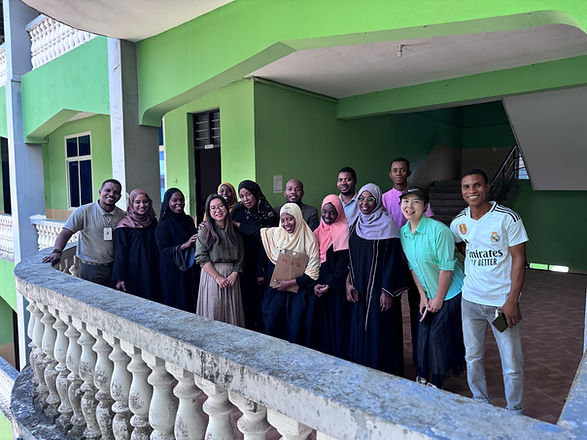
PROJECT TEAM AND PARTNERS
This initiative brings together collaborators from higher education, educational research, and community-based practice. Our team combines expertise in AI-supported learning, curriculum design, teacher development, field implementation, and partnership-based educational innovation.

Dr. Xiao Huang
Emory University
Dr. Xiao Huang is an Assistant Professor in the Department of Environmental Sciences at Emory University. His expertise includes human-environment interaction, computational social science, urban informatics, GeoAI, and disaster remote sensing. He has nearly 6,000 Google Scholar citations, has published over 200 peer-reviewed journal articles and 20+ book chapters, and has edited five books. He is ranked among Stanford/Elsevier’s World’s Top 2% Scientists and has received research support from NSF, NASA, the Gates Foundation, the National Academies, and CMS.

Dr. Siqin Wang
University of Southern California
Dr. Siqin (Sisi) Wang is an Associate Professor of Spatial Sciences at the University of Southern California. Her work focuses on GIScience, spatiotemporal big data analytics, computational social science, digital health geography, human-centered GeoAI, human mobility and migration, smart cities, and human-climate interactions. She was named one of Geospatial World’s 50 Rising Stars in 2024, and her work has received recognition including the 2022 Best Paper Award and Most Downloaded Paper from Annals of GIS in 2023.

Ms. Xianyi Li
SAY Foundation / Zanzibar, Tanzania
Xianyi Li is Chairperson of the Sino-Africa Youth Foundation in Zanzibar, Tanzania. She is an education leader with more than 12 years of experience advancing educational initiatives in Zanzibar. She founded the SAY Foundation and manages a 21,700 m² education base that is evolving into an AI Education Center. Her work includes training 200+ Swahili-speaking Chinese teachers, launching the “Sino-Africa Friendship Classrooms” initiative, helping integrate Chinese into Zanzibar’s national curriculum in 2023, and designing an AI-powered education center in 2025. Her project contributions include localizing content for Zanzibari learners, bridging language and cultural gaps in AI materials, providing infrastructure support through the SAY AI Center, and facilitating policy integration.

Dr. Xuebin Wei
James Madison University
Dr. Xuebin Wei is an Associate Professor at James Madison University and an AWS Academy Certified Educator. His teaching focuses on cloud-based Python programming, data mining and modeling, data visualization, machine learning, and AWS-based data analysis. He is a Faculty Ambassador for the AWS Educate Cloud Ambassador Program and received JMU’s 2019 Excellence in Teaching & Learning with Technology Award. His research examines how large-scale location-based social media data can reveal patterns of human activity and social interaction.
Who Stands With Us
This work is borderless because the people behind it are. We are grateful to every institution, university, and individual who stands with us.


